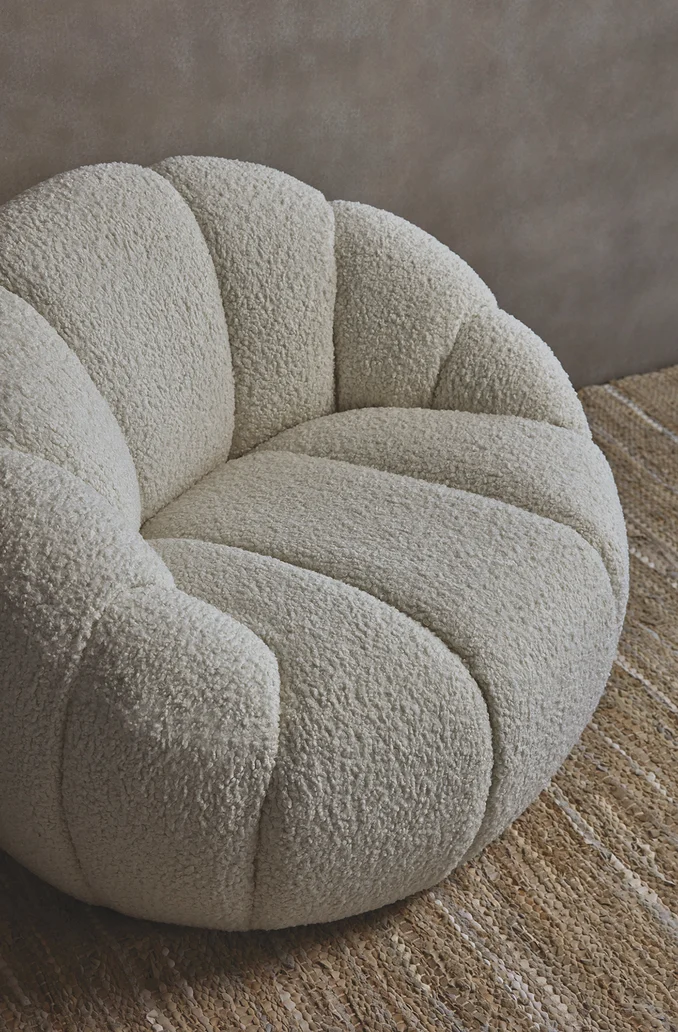
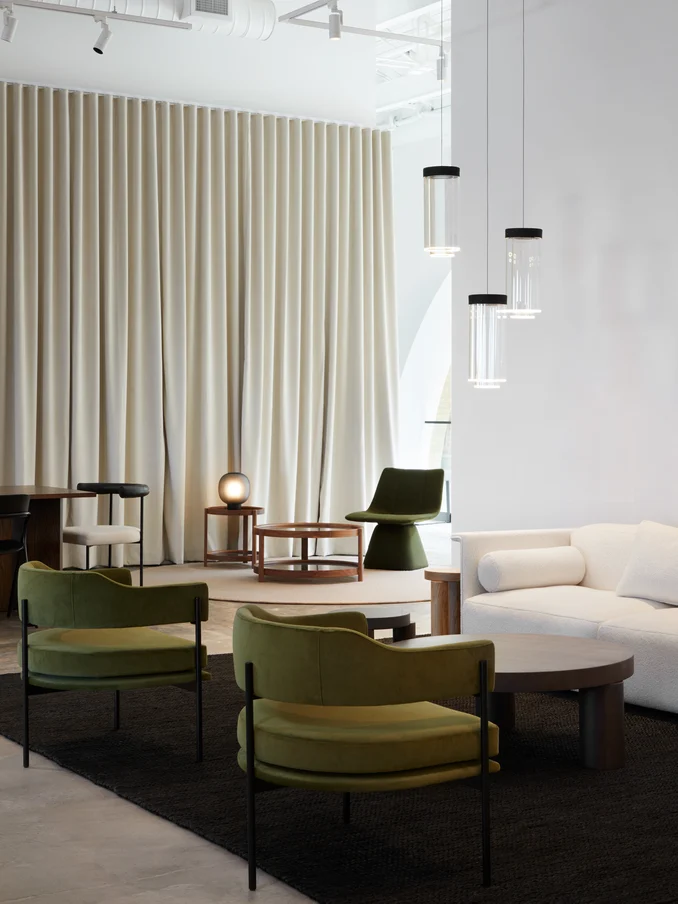
Sculptural pieces of curved furniture add softness to the hard lines of our homes

Journal

Orb Sofa by Arthur G in Grande Boucle colour Aquamarine by Catherine Martin by Mokum | Image by Timothy Kaye & Bek Sheppard
Hugging the curve
The resurgence of mid-century modern and our current 1970s nostalgia has encouraged contemporary furniture designers to take inspiration from the curvaceous lines of masters like Pierre Paulin, Jean Royere, and Giancarlo Piretti. In this article we take a closer look at curved pieces from the past and present, divulging a few manufacturing secrets and discussing which upholsteries emphasize their curves!
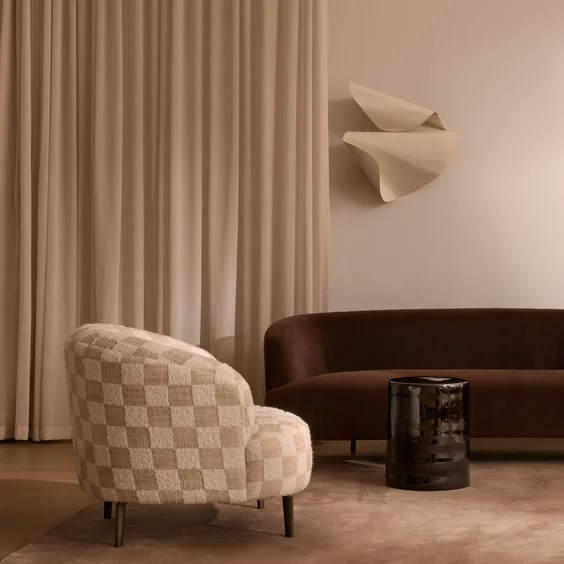
Orb MKII Chair by Arthur G in Quadro Boucle colour Chalk and Orb MKII Sofa in Alpaca Velvet colour Cacao, both by Mokum | Image by Lillie Thompson
A TRUE CURVE
A TRUE CURVE
An upholstered piece of furniture with a true curve is a rare find. One famous example is Danish Modernist Arne Jacobsen’s Egg Chair, first constructed in wire and plaster in the designer’s garage. The shape is achieved without seams and the chair is generally upholstered in felted wool or leather, both extremely malleable, strong textiles capable of curving into the back of the chair without requiring visible anchor points to hold it in place. Unfortunately, vinyl cannot mould to the surface like a natural leather can and is therefore an unsuitable choice.

Egg Chair by Arne Jacobsen | Images sourced from Pinterest
Alpaca Velvet by Mokum is the perfect solution for curvaceous furnishings in both residential and commercial interior schemes. Our luxurious wool blend velvet is woven in Italy and the deep, dense pile delivers a sophisticated treatment to both modern and classic applications while the wool component ensures malleability.
When asking a fabric to curve in two directions, such as on the backrest of the Kashmir Stool by Simon James for Resident, a four-way stretch is required. Leather and felted wool are the only fabrics capable of four-way stretch; if you would like to use another fabric type such as weaves or cut pile velvets etc., seams will be needed.
Modern fabrics are typically constructed with a backing to enhance the upholstery’s ability to slide across the foam without wear to itself or the foam when in use. This increases the lifetime of both the fabric and the foam; however, it makes four-way stretch an impossible task.

A BEAUTIFUL ILLUSION
A BEAUTIFUL ILLUSION
Most curvaceous furniture is expertly crafted in panels, with seams joining bias-cut pieces of fabric to form the illusion of a curve. This craftsmanship doesn’t require a specific fabric, the choice is yours, however, it is important to be conscious of where the seams will be placed and how the pattern or stripes will meet. Textured fabrics, such as Fleece by James Dunlop, and non-directional pile fabrics, such as Bespoke by Catherine Martin by Mokum, are ideal to upholster an architectural piece of furniture, allowing the structural form to be the star.
Popular in both residential and commercial spaces, the Isabella Chair by Simon James for Resident and the Spyder Chair by Kovacs are constructed with two or four seams on the backrest. By cutting the fabrics on the bias and incorporating seams into the design, the fabric can mould to the chair without bagging or rippling around the curve.

Digital render of the Spyder Chair by Kovacs in Leopardo by Catherine Martin by Mokum
A little stretch on the bias is essential for organic furniture pieces, allowing the fabric to remain taut in the back of the chair and hug the curve without puckering. Elasticity enables a fibre to return to its original length, shape, and size immediately after the removal of stress, and unlike natural fibres, synthetic fibres tend to have little to no stretch. You should always check the elasticity of the fabric with your manufacturer to ensure it is suitable for the style of furniture you have chosen.
Through carefully selecting the mills we work with, optimising the operations of our production facilities, and ensuring we are developing textiles people want, we can be confident that we are creating fabrics that balance usefulness and longevity with their environmental impact. So far, we have ...
